
Development: Environmental and Human Security
- Paola A. Granados Jaramillo
- Jan 13, 2023
- 5 min read


Three different projects/writing samples are briefly presented addressing the precariousness that surrounds development projects within the frameworks of environmental and human security.
The global threat of climate change has compelled the international community to join hands and adopt innovative solutions to reduce carbon emissions. One such solution is the Clean Development Mechanism (CDM) under the Kyoto Protocol to the United Nations Framework Convention on Climate Change which was adopted in 1997, and entered into force in 2005.This paper adopts a case study approach by looking at the Barro Blanco Project in Panama which was envisaged under the CDM, and allegedly resulted in human rights violations and enhancement of precariousness of local communities i.e. the Ngabe indigenous community. First, the paper explains the methodology adopted; secondly, it outlines the theoretical framework within which the Project will be analysed; thirdly, it provides the background to the facts of the case and the rationale for its selection; fourthly, it analyses the nature of violations due to the Project and the role of diverse stakeholders; and lastly, it provides our conclusions and recommendations, especially relevant to the market mechanism envisaged under Article 6 of the Paris Agreement (2015), called the Sustainable Development Mechanism. In this collaborative research and case study paper, I contributed to the writing of the Introduction, Research Question and Methodology, and helped edit some sections of the Case Analysis. The paper was submitted on January 2022.
The following is a concept note written to signal SDG gaps in the Maldives. The purpose was to pitch the necessity to create a development program that would enhance environmental and overarching human rights, sustainable development practices, and positive peace. Once accepted the program would be drafted in groups of five.
Slides 2-4: As a Small Developing State made of 1192 coral islands, the Maldives faces significant economic, social and environmental challenges which are exacerbated by internal and external shocks such as financing, capacity building, and resource mobilization in coordinating development projects nationwide. After the institutionalization of the tourism industry in the 1980s and adoption of the MDGs, the Maldives has made substantial progress in eradicating poverty, achieving universal education and healthcare, and protecting terrestrial and marine biodiversity (Firaag 1997;World Bank 2021). However, there are gaps in areas such as gender equality, inequalities among migrant workers, strengthening mechanisms of governance and justice, and the promotion of sustainable approaches for ecotourism to ensure that no one is left behind (USDS 2020;HRW World Report 2021).
Slide 5: Article 251 of the Maldivian constitution prohibited foreign ownership and military purposes in any part of the Maldivian territory, however, after the 2015 amendment foreign nationals and entities have been granted the right to own freehold land, including entire islands with an investment of more than $1 billion in a project (LOC 2015). Since, much of the reefs have been damaged by dredging, locals have complained of tree grabbing, and the reclaimed land that has been sold to be developed as resorts has enhanced human rights violations in relation to the environment that the Maldivian state was an advocate for.
Slide 6: Several cases of large scale vegetation being uprooted from islands like Mendhoo and Bandidhoo to be transported to developing resort islands Emboodhoo, Sun Aqua Iru Veli, Aluvifushi, Dhaalu Atoll, among others for greenifying and landscaping purposes failed to mention the project's impact on the island's local economy. Bandidhoo is a community of people with little to no resources that depend on their palm groves as an income source and the people of Meedhoo Nilandhoo, Hulhudheli and Kudahuvadhoo share Bandidhoo’s coconuts that are not sold in the capital Male, while for inhibited islands the discourse has followed agro-farming projects like the one on Mendhoo (Aiham 2020;Maldives Independent 2019;Junayd 2018).
Slide 7: With the newest 48/13 resolution on having a clean, healthy and sustainable environment as part of human rights, it is necessary to highlight the work of the Maldivan government in their social, economic, and infrastructural on agendas to continue protecting residents' human rights in relation to the environment (UN News 2021). Solid waste, untreated sewage, oil pollution and ballast water constitutes the major sources of marine pollution in the country. The growing amount of waste generated and the lack of sufficient capacity for sound management of waste on the islands is one of the most challenging environmental issues related to life below water in the Maldives (Ministry of Environment, Climate Change and Technology 2017). Moreover, there has been a lack of enforcement of environmental protection laws governing development projects.
Lastly, the COVID-19 pandemic exacerbated existing inequalities and abuses, disproportionately affecting the livelihoods and wellbeing of migrant workers and women. Maldives Immigration reported approximately 63,000 undocumented foreign workers, mostly from Bangladesh and other South Asian countries working in the construction and tourism industries who faced harassment and violence by local citizens, and discriminatory policies by government agencies. Women on the other hand faced increased domestic violence, and increased harassment and attacks on social media and in public by islamist extremist. (HRW World Repor 2021;Mohamed 2021;HWR 2020).
Note: Although the winning and final program was developed to address enforced disapperances in Mexico. This concept note provides some food for thought when it comes to having a clean, healthy and sustainable environment as part of human rights, as well as raising awareness on human-environmental issues that are otherwise overlooked on international public discourse.
The following slideshow and document are based on a research paper that discusses food insecurity --which includes food related infections and reduced yields due to land degradation. Based on the General Agreement on Trade Services (GATS), much of the growth in global exports in the past decade has been a result of sharp rises in agricultural exports from developing countries. For example, developing country exports to the United States grew from $25 billion in 2004 to over $55 billion in 2013 (USDA, 2015). The paper has the purpose to analyze how food related infections could potentially cross borders and how decreased food production will imminently affect the health and nutrition of developing countries’ trading partners. While developing countries will be directly affected by human-induced climatic changes, other countries’ will be affected indirectly from these climate change impacts due to global interdependence. Developed countries should understand the indirect effects disrupted food systems will have in their communities' health. Specifically the low income communities that rely on affordable food products that have been imported and cause domestic competition. During a food crisis prices will increase affecting mostly the low income population and food related infections will create a lot of import regulations on top of climate induced food scarcity.




References for the Maldives
Aiham, A. 2020. “Public concern over Bandidhoo tree grab.” The Edition. November 3, 2021. https://edition.mv/tree_grab/14547
Firaag, I. 1997. “Tourism and the Environment: Current Issues for Management” in Workshop on Integrated Reef Resources Management in the Maldives. Bay of Bengal Programme https://www.fao.org/3/x5623e/x5623e00.htm#Contents
Human Rights Watch (HRW). 2020. “Human Rights Watch World Report 2021”. Human Rights Watch. November 1, 2021.
Human Rights Watch (HRW). 2020. “Maldives: Covid-19 Exposes Abuse of Migrants”. Human Rights Watch. November 1, 2021.
Junayd, M. 2018. “#MvTreeGrab: Removal of trees continues for landscaping of resorts.” Maldives Independent. November 3, 2021.
Library of Congress (LOC). 2015. “Maldives: People's Majlis Passes Amendment to Constitution Allowing Foreign Ownership of Land” Library of Congress. November 3, 2021. https://www.loc.gov/item/global-legal-monitor/2015-07-30/maldives-peoples-majlis-passes-amendment-to-constitution-allowing-foreign-ownership-of-land/
Maldives Independent. 2018. “EPA under fire for authorising ‘tree grab.” Maldives Independent. November 3, 2021. https://maldivesindependent.com/environment/epa-under-fire-for-authorising-tree-grab-144515
Ministry of Environment, Climate Change and Technology. 2017. "Voluntary National Review for the High Level Political Forum 2017”. Republic of Maldives. November 1, 2021.
Mohamed, S. 2021. “Protecting Migrant Workers in Maldives.” International Labor Organization. November 1, 2021. https://www.ilo.org/wcmsp5/groups/public/---dgreports/---inst/documents/publication/wcms_776391.pdf
UN News. 2021. “Access to a healthy environment, declared a human right by UN rights council.” United Nations News. November 1, 2021.
United States Department of State (USDS). 2020. “2020 Country Reports on Human Rights Practices: Maldives.” United States Department of State. November 1, 2021. https://www.state.gov/reports/2020-country-reports-on-human-rights-practices/maldives/
World Bank. 2021. “The World Bank In Maldives.” World Bank. November 1, 2021. https://www.worldbank.org/en/country/maldives/overview#1
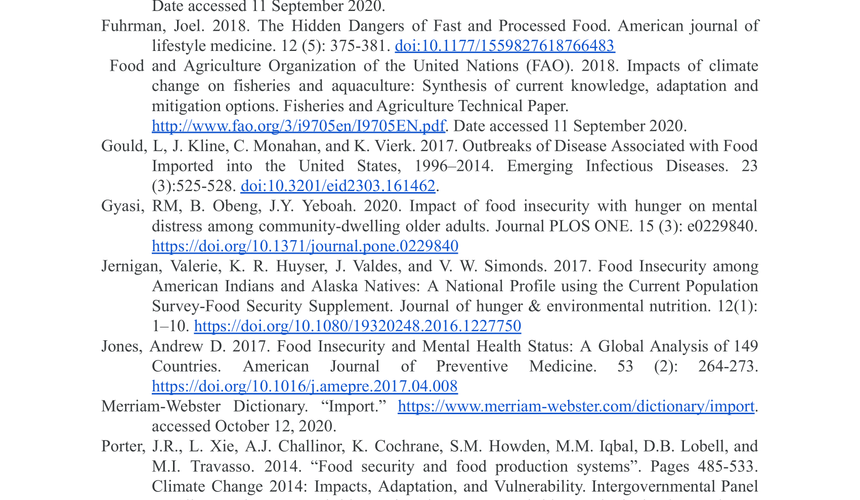
Reference for U.S. food insecurity
United States Department of Agriculture. 2015. South-South Agricultural Trade on the Rise. United States Department of Agriculture: Foreign Agricultural Service. https://www.fas.usda.gov/data/south-south-agricultural-trade-rise#:~:text=In%20fact%2C%20since%202004%2C%20total,52%20percent%20from%20developed%20countries.
Comments