
Counter-Power in Latin America
- Paola A. Granados Jaramillo
- Jan 12, 2023
- 8 min read

How much power do Latin Americans have?
The following argument and presentation address the extent to which Latin American people and/or governments have been able to challenge U.S. influence; covering the conditions and/or strategies that have increased and/or limited U.S. control in the region decades since 1945.
Context:
Slides 2-3: Ever since the formation of the United States, but even more so after the ratification of the Monroe Doctrine in 1823, the United States has exercised multiple variations of its power on Latin American countries to protect its interest. Evidence of this comes from the recent statements of Secretary of State John Kerry and National Security Adviser John Bolton reaffirming the vital importance of Latin America to the country, as well as the permanence of the policy with its expansion into the Kennan Corollary in 1950 aiming to, for one, prevent communist influences in Latin American. Considering this, power can be defined as the ability to shape the thoughts and actions of actors at the various socio-ecological levels via complex dynamics that go beyond simple coercion.
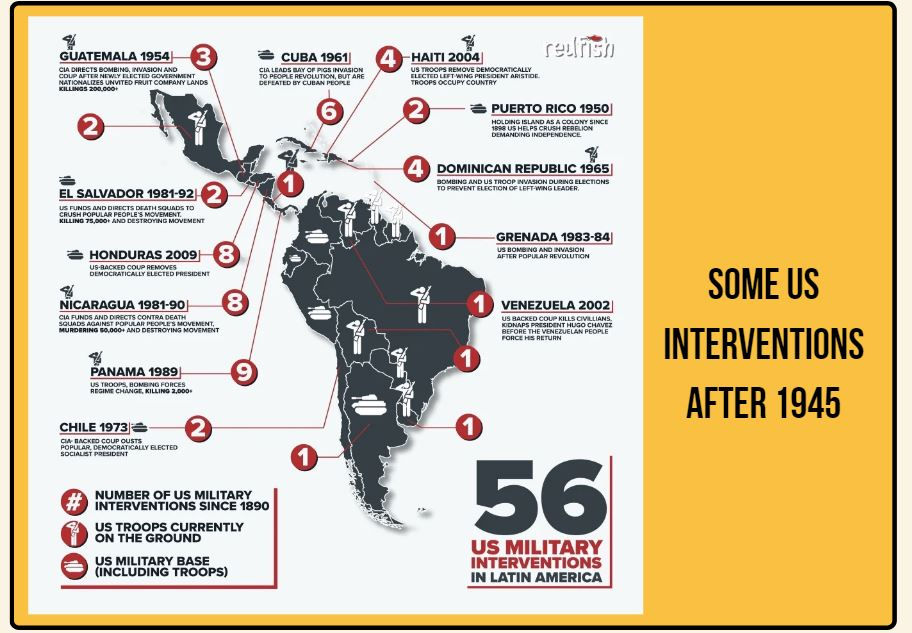
Cold War interventions in Central America date back to the CIA-sponsored coup in Guatemala in 1954. The United States used the Organization of American States (OAS) to isolate Guatemala diplomatically, worked with us businesses to create an economic crisis, and funded and equipped a paramilitary group formed by exiles to reduce the population's support of the Arbenz government. As per why these actions became relevant within United States foreign policy, more than containment of communist it focused on the protection of the country’s international political economy. President Arbenz attempted to nationalize and redistribute land via the 1952 agrarian reform law to empower farmers, increase their salaries, and improve the economy.
Slides 4-5: After the PBSuccess, as the CIA dubbed its campaign to overthrow the Arbenz government, was regarded a massive success, the United States government continued to implement similar approaches in the rest of Latin America until the end of the 20th century. To outline, PBSuccess relied on the State and Defense Departments to isolate Guatemala diplomatically, militarily, and economically, whilst at the community level the use of “psychological warfare”via propaganda aimed at discrediting the enemy and building support for allies. So far, only Cuba with the results of the 1961 Bay of Pigs invasion and the permanence of the Castro government has not succumbed to U.S. power via a variation of these tactics.
Slides 6-7: In the 1970s, the United States was very involved in aiding Central American militaries in their fight against communism which can be understood as preserving US economic and ideological influence on the region. It supplied Guatemala, El Salvador, and Nicaragua with direct military aid to help them prevent and control dissidents and larger insurgencies. Even though the United States has directly intervened with military and financial aid, it has also used other than the OAS a variety of political and financial organizations to influence the domestic and foreign policies of Latin American governments. Nonetheless, Latin American governments and their people have proven their ability to exert and resist United States power as long as they receive meaningful internal and external support. This means how much support a government and its policies receives from its people, as well as the support from other Latin American countries to undermine the international image and policies of the United States.
There will be two case studies: El Salvador and Cuba.
Slide 8: Despite the support of Jimmy Carter's administration for El Salvador’s military government during the remainder of the 1970s, Congressional Democrats attempted to reduce political repression within the country by reducing its military aid and reforming the Salvadoran military into a competent counterinsurgent force that would respect human rights. Respect for human rights meant continuing the use of violence to an appropriate degree, the militarization of the countryside, the provision of food and other basic necessities, and the employment of small-unit search-and-destroy operations so the government could be stabilized, legitimized, and the economy more equitable.
Nonetheless, the repression escalated all throughout the 1980s and the administration of president Raegan decided to transfer the country's leadership to José Napoleón Duarte in the 1984 presidential election, as well as provide financial support for nonmilitary projects, reformist political parties, labor unions, and oppositional organizations not aligned with the guerrillas that would develop infrastructure, reform the judicial system, and cultivate a coalition of responsible business elites capable of acting as a balance to the continued military violence.
Slide 9: Some violent acts taken were large-scalesweeps through the countryside such as El Mozote massacre, indiscriminate bombing and aerial attacks made possible by U.S.-supplied helicopters and planes. Overall, the war claimed the lives of more than fifty thousand Salvadorans, the majority victims of government forces.
So what sort of powers limited Salvadoran freedom from US influences? To start off US financial power in the form of money and assets such as helicopters provided to the repressive military government, as well as discursive and political power which helped framed the undertaken violence especially under President Duarte’s administration as legitimate and necessary to halt Farabundo Martí National Liberation Front (FMLN) insurgents whom by 1988 was still deploying more than seven thousand rebels backed by a supporting militia of forty thousand people.
Slide 10: So how where Salvadoran people via the FMLN able to resist and survive more than a decade war?
While terrorism worked in El Salvador to prevent an insurgent takeover of the state, the FMLN remained undefeated because it was still able to mount serious military offensives and claim the loyalty of large sectors of both the rural and the urban population. Maria Serrano FMLN guerrilla leader traveled from village to village organizing the peasant population while her husband would bring supplies into the camps. On the film Maria's Story we learn not just about Maria’s life in the guerilla but how the FMLN was able to negotiate that any cessation of hostilities be contingent on the implementation of land reform, reform of the judicial system, dismantling of the deathsquad apparatus, reforming the military, and political power-sharing among other initiatives.
Considering the background of members of the insurgency: mainly poor farmers. They would spend 60¢ a day per person for food, steal and buy guns from the army and the black market in general, and engage with international support groups to receive food and medicine. Esperanza, a community organizer for repopulated communities in El Salvador expressed her joy that her and Maria’s dream of seeing farmers with good harvest without paying rent for the land, schooling, and the creation of a clinic because of the protection of the F.M.L.N.
Maria as an example of the work and mutual support of the FMNL with the civilian population showcase how the discursive and informal political power of the group with the community promoted the quasi-financial power provided by the rural and urban communities as well as the international support groups. Discursive power and informal political power in this case means the provision of food, schools, and healthcare.
Slide 11: After the Cuban revolution and inability of the United States to manipulate the new Cuban government the US adopted a hostile attitude towards the country and the determination to overthrow its government. On April 6, 1960 the deputy Assistant Secretary of State for Inter-American Affairs wrote a memorandum detailing a policy that will weaken the Cuban economy and turn Castro’s Cuban support against him. Up until then the United States did not find any internal political opposition to use for counterinsurgency methods. Moreover, during his presidency, Fidel Castro and other members of the Cuban government did not show condemnation against communist influence but rather accepted it and spread its ideas with the rest of the country. As of containment and the Monroe doctrine the United States believed the only way to create opposition within Cuba was to use Cuban exiles and other covert tactics that will undermine and overthrow Castro.
Slide 12: Some of the countermeasures and strategies from the Cuban government are the creation of the Committee for Defense of the Revolution to work as a community watch program and sending intelligence agents to infiltrate the Cuban-American organizations. For instance, Pedro Juan Pablo Roque, a Cuban-American double agent prevented terrorist attacks against Cuba and was given an order from CIA agent Basulto to spray the tobacco crops of his acquaintance Robaina, however, he changed the chemical that quickly destroys the crop for a harmless one. Similarly, The Cuban Five infiltrated on Cuban-American organizations to protect their country although in comparison to Roque they were arrested on June 8, 1998 and sentenced in September 2001 for a total of four life sentences of 75 years under espionage charges. There have been a minimum 23 events of biological terrorism recorded against Cuba such as the introduction of Dengue, Influenza, Sugar Cane Rust, Tobacco Fungus, among others on reports and testimonies from former CIA agents.
Slide 13: More recently, to contrarest the United States embargo that was imposed to undermine investments in the Cuban economy, the Cuban government has created medical brigades and partnerships with countries in Latin America, Africa, the Middle East, and Europe. By 2018 the leasing of medical professionals became Cuba’s most lucrative export activity among rum, sugar, and cigars combined and it generated $6.4 billion, whilst by 2020, there were more than 28,000 Cuban health professionals who were working in 59 countries. All this despite the United States negative coverage calling the missions human trafficking even when doctors participate in the program voluntarily due to its high economic benefits not only for themselves but for the country welfare systems such as free health care and education throughout the university level.
Variations of discursive, financial, and political power can be found in all the Cuban government initiatives. It’s political power has allow it to create alliances with countries that can’t afford to pay for doctors and in exchange they receive petroleum shipments from for example Venezuela and Angola. Its financial power via its funding of welfare programs and the Latin American School of Medicine serve as a reinforcer of its political legitimacy as well as international image with the graduation of 29,000 doctors from more than 100 countries over the last 20 years.
Even when the United States government continues its economic war against Cuba the country has found new strategist for collaboration across from which is its discursive power. The framing of medical brigades during covid-19 pandemic for example has been defended by international journalist such as Ed Agustin that claim its humanitarian importance. The strength of discursive power doesnt necessarily need to come from the Cuban government itself but also from allies that can dismiss and/or clarify US propaganda influencing governmental rhetoric of countries such as Ecuador, Bolivia, and Brazil that have cancel accords with Cuba and for Cuba to withdraw more than 9,624 of its medical forces. Actions taken mostly to ensure US financial support via the IMF for example. Cancelation of medical collaboration with Cuba during the Covid-19 pandemic is framed not only as an attack to cuba financial and diplomatic relations but as an attack to the population of the countries previously mentioned as these decisions cut back access to health care for 28 million people in Brazil for example.
References
Augustin, Ed “Cuba Has Sent 2,000 Doctors and Nurses Overseas to Fight Covid-19,” The Nation, May 22, 2020
Aviva Chomsky, A History of the Cuban Revolution, second edition (Malden, MA: Wiley-Blackwell, 2015), 54-74
Bolender, Keith. Voices from the Other Side : An Oral History of Terrorism Against Cuba, Pluto Press, 2010, 22-226
Document 20: Selected documents on Guatemala
Document 21: Fidel Castro, “Socialist and Democratic Revolution in Cuba,” 1961
Document 22: Fidel Castro, “From Martí to Marx,” 196
Document 24: Lester Mallory, “Inauguration by the U.S. Government of a Policy to Weaken the Cuban Economy,” 1960
Grandin, Greg. 2007. Empire's workshop: Latin America, the United States, and the rise of the new imperialism. New York: Owl Books
Week 1 PPT: Manifest Destiny and the Monroe Doctrine, January 27th 2022, 23-25
Week 3 PPT: Bananas and Business, February 10th 2022, 5
Week 3 PPT: The Cuban Revolution, March 3th 2022, 6
Week 9 PPT: The U.S. Response beyond Cuba, March 24th 2022, 12
Week 10 PPT: The Enemy in Central America, March 29th 2022, 7-8
Comments