
Climate Communication and Education
- Paola A. Granados Jaramillo
- Jan 12, 2023
- 1 min read

Levels of climate change awareness, knowledge, perceived risk, and support for mitigation or adaptation vary greatly across the world. When government agencies and NGOs attempt to educate the public about climate change, the focus is typically on scientific aspects, harm to non-human forms of life (such as plants, penguins, and polar bears), or impacts to aspects of the environment (such as glaciers).
In the case of United States' public discourse, frames that dominate Climate Change education include environmental, political, and economic rhetorics —all of which have been highly polarizing,— as well as a scientific frame, which resonates with few people. Hence, most citizens are not aware of the specific health impacts caused by Climate Change, and there is a need to provide them with information on its direct association to increased risk of specific illnesses and death.
Local environmental conditions and socio-economic circumstances affect human health
Directly: with impacts of thermal stress, death/injury in extreme weather events; and
Indirectly: through changes in the ranges of disease vectors, water-borne pathogens, water quality, air quality, and food availability and quality.
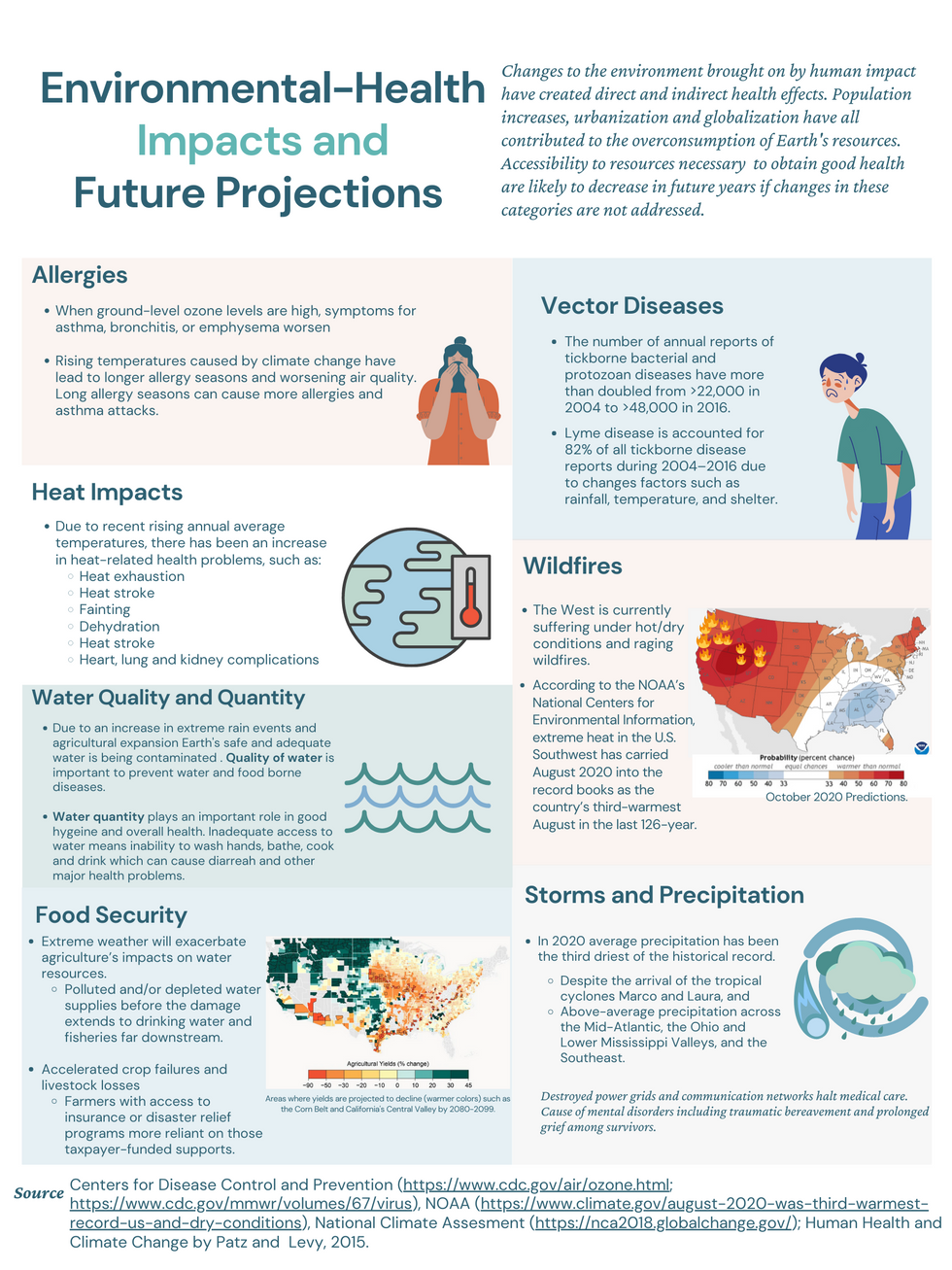
It is under this context that the following flyer was developed, showcasing the human health frame: the tight relationship between the threat posed by Climate Change, health, and the environment.


Comments